What Kind of Apartment Is Worth Buying to Renovate?
Not every apartment in poor condition represents an opportunity. The real question is whether renovation can create value that is not already reflected in the purchase price.
· Erdész Zoltán, MBA · Budapest Buyer's Agent
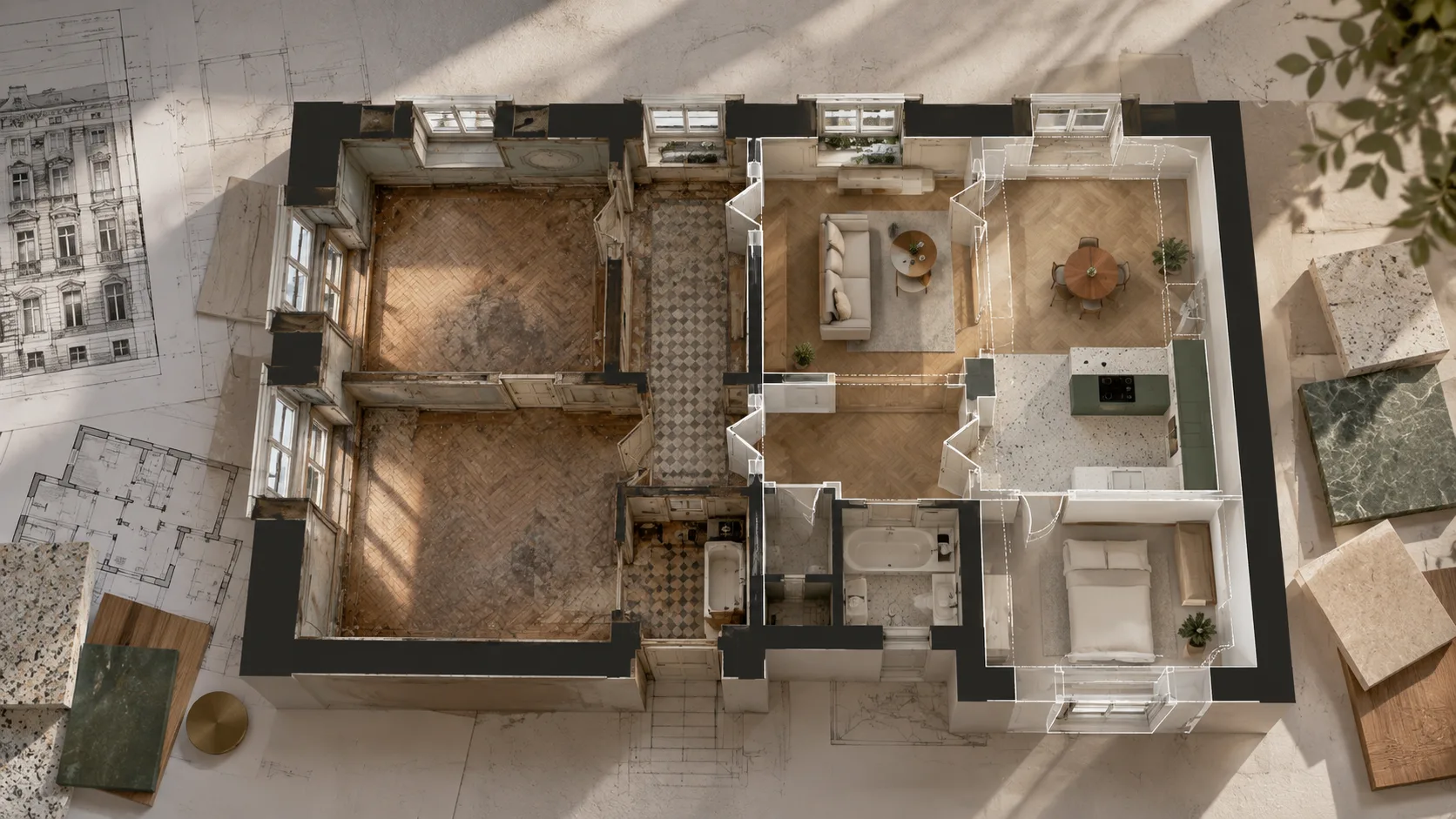
It is easy to see potential in an apartment that needs renovation.
An old kitchen can be replaced. Worn parquet flooring can be restored. A bathroom can be completely redesigned. Walls may be moved, new lighting can be installed, and within a few months an apartment that has not been modernised for decades can become a very different property.
But that does not mean every apartment in need of renovation is a good purchase.
When evaluating a property, the first question should not simply be what the apartment could look like after renovation. We need to understand which problems can actually be changed, what those changes will cost, and what kind of value we will have created at the end of the process.
Poor condition and poor fundamentals are not the same thing
This is perhaps the most important distinction when evaluating an apartment that needs renovation.
Flooring, paintwork, kitchen units, sanitary fittings and even the condition of the electrical system are primarily technical and financial issues. With an appropriate budget, many of these can be changed.
Other characteristics, however, can hardly be changed at all.
These may include:
- natural light,
- orientation,
- street or courtyard noise,
- floor level,
- the view,
- the apartment’s position within the building,
- the condition of the condominium building,
- and, of course, the location itself.
A dark apartment may still be a dark apartment after a beautiful renovation. High-quality windows can help with traffic noise, but they cannot change the character of the location. An apartment in poor condition that has good natural light, a strong location and a layout with real potential may be a very different proposition.
With renovation properties, it is therefore often worth looking for what is already good – even if it is less obvious at first sight.
The layout can offer the greatest opportunity – or create one of the biggest problems
An outdated layout is not necessarily a problem in itself.
Older Budapest apartments often contain spaces that do not fit modern expectations particularly well: oversized entrance halls, interconnected rooms, small separate kitchens or inefficient corridors.
In some cases, these can be redesigned relatively effectively.
But not every wall can be moved, and not every room can be relocated wherever we would like.
Structural walls, service risers, chimneys, mechanical systems, the position of windows and doors, and condominium rules can all limit what is possible.
For this reason, it is not enough to look at a renovation property and say, “we will simply redesign it.”
The real question is whether the proposed changes are technically and legally feasible, what they will cost, and whether they will actually result in a better apartment.
What needs renovating matters
Two apartments that appear to be in similarly poor condition may require very different levels of work.
One may primarily need cosmetic improvements: painting, new flooring, a kitchen and a bathroom.
Another may require all of these as well as a complete upgrade of the electrical system, plumbing, heating or windows.
The difference is not only financial.
A complex renovation also means more time, more contractors, more coordination and more uncertainty.
This is why it is not enough to see that an apartment requiring renovation is, for example, HUF 15 million cheaper than a property in good condition.
We also need to understand how much must be spent before the two properties are genuinely comparable.
Renovation cost is not the same as value creation
This is one of the most common misunderstandings.
Spending HUF 20 million on renovating an apartment does not automatically increase its market value by HUF 20 million.
The market does not reimburse our invoices.
Buyers value the property that has been created.
An expensive surface finish or premium kitchen solution may cost a significant amount while a future buyer may not be willing to pay an equivalent premium for it.
In other cases, a well-considered layout change, better use of previously inefficient space or the creation of an additional bedroom may generate more value than the cost of the work itself.
Renovation is therefore a cost. Value creation is an outcome. The two are not necessarily the same.
Look at the total acquisition and renovation cost
The purchase price of a renovation property is difficult to assess in isolation.
The real question is how much the property will have cost by the time it is in the condition in which we want to use it, rent it out or eventually sell it.
In addition to the purchase price, this means considering transaction-related costs, planning, construction work, materials, mechanical systems, the kitchen, lighting, potentially furnishing, and unexpected expenses that arise during renovation.
There is also another, less visible cost: time.
If an apartment cannot be used or rented for several months, that also has an economic impact.
This is particularly important when buying for investment purposes.
You cannot renovate the entire building together with the apartment
The interior of an apartment can be transformed almost completely.
The condominium building cannot.
This makes it especially important to understand what exists beyond the apartment’s front door.
What is the condition of the roof, façade, lift and common mechanical systems? Are major works planned? Does the condominium have adequate renovation reserves? What is its financial position?
A problematic building can affect both the value and the future resale potential of an otherwise beautifully renovated apartment.
We control the renovation budget inside the apartment. We have much less control over future expenditure at building level.
An apartment needing renovation is not automatically cheap
Poor condition can easily create the impression that a property is attractively priced.
That is not necessarily the case.
Apartments with good locations, strong fundamentals and attractive renovation potential may also draw the attention of other buyers and investors. If many buyers recognise the same opportunity, part of the value that could be created through renovation may already be reflected in the asking price.
The buyer may then take on the full cost and risk of the renovation while already paying for a significant part of the potential upside in the purchase price.
For this reason, “needs renovation” is not an investment strategy in itself.
The right choice may be different for an owner-occupier and an investor
When buying a home for personal use, one of the major advantages of renovation is the ability to adapt the apartment precisely to our own needs.
That has value in itself.
For an investment, the question is different.
We need to consider how attractive the completed apartment will be to the target tenant or a future buyer, and how the money invested in the renovation will be reflected in achievable rent or property value.
The most expensive solution is not necessarily the best one. Neither is the cheapest.
The objective is to create a property that is valuable to the relevant tenant or buyer group.
A typical decision
Imagine two similarly sized apartments in the same neighbourhood.
One has already been renovated, is in good condition and can be used immediately.
The other is significantly cheaper but requires a complete renovation.
At first glance, the second property may appear to offer the better opportunity.
But once we add the full renovation budget, unexpected expenses and the cost of time to the purchase price, the total investment in the two apartments may become surprisingly similar.
At that point, different questions become important.
Which apartment has better natural light? Which has the stronger layout? Which building is in better condition? Can the renovation property genuinely become a better apartment than the already completed alternative?
What matters is not how much we spend on renovation, but what we receive for the total amount invested.
Where can genuine value be created?
The most interesting renovation properties are often not the ones in the worst condition.
They are the ones where the current condition hides strong fundamentals.
An apartment may be dated, poorly furnished or untouched for decades while still having excellent natural light, a suitable floor level, a good location, a well-managed building and a layout that can be improved sensibly.
In these cases, poor condition can represent an opportunity.
Not because every renovation automatically pays for itself, but because the buyer may be able to solve a problem that the market currently discounts while the property's difficult-to-change characteristics are already strong.
A good decision begins before the purchase
When buying an apartment to renovate, it is easy to imagine the finished property before the work has even begun.
Before making an offer, however, it is worth returning to the apartment as it actually exists today.
What are we really buying?
Which problems can be fixed? Which ones will remain? What work will be required? How reliably can the costs be estimated? And what kind of property will we own at the end of the process?
Renovation can represent a genuine opportunity when we answer these questions before making the purchase decision.
Frequently Asked Questions
Is an apartment that needs renovation a better purchase than a renovated one?
Not necessarily. The purchase price should be considered together with the full renovation budget, the time required, the risks involved and the expected value of the apartment after completion. In some cases, an already renovated apartment may offer better value.
Which property characteristics cannot be changed through renovation?
Location, natural light, orientation, position within the building, floor level and the surrounding environment generally cannot be changed, or can only be influenced to a very limited extent. An individual apartment owner also cannot independently solve the overall condition of the condominium building.
Can the layout of every apartment be changed?
No. Structural walls, service risers, chimneys, windows, doors and other technical characteristics can significantly restrict the possibilities. Certain changes may also be subject to condominium or regulatory requirements.
Does the full cost of renovation increase the property's value by the same amount?
Not necessarily. The amount spent on renovation and the increase in market value are two different things. The market primarily values the resulting property, not how much the owner spent on the work.
What should investors consider when renovating an apartment?
The completed apartment should meet the needs of the intended tenant or future buyer group, while the total investment should remain proportionate to achievable rent and expected property value.
When can an apartment in need of renovation be particularly interesting?
When poor current condition hides strong characteristics that are difficult to change: a good location, natural light, a suitable floor level, a functional or sensibly adaptable layout and a sound condominium building. In such cases, renovation may genuinely create value that is not yet fully reflected in the purchase price.