How Do You Know Whether an Apartment’s Asking Price Is Realistic?
The price at which an apartment is advertised does not necessarily tell us what it is worth. The question is how that price compares with the genuine alternatives available on the market.
· Erdész Zoltán, MBA · Budapest Buyer's Agent
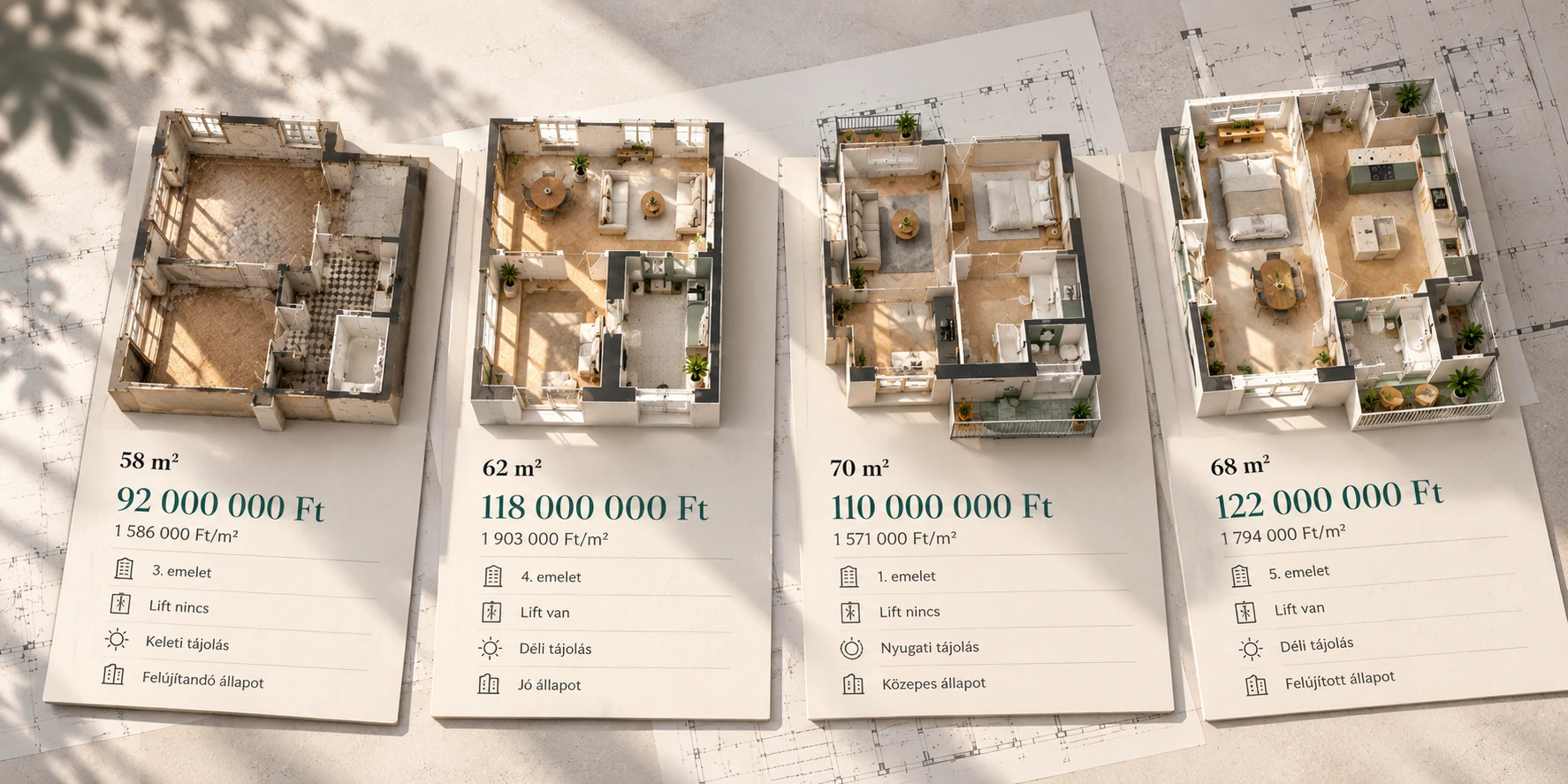
When searching for an apartment, we can form an impression of prices surprisingly quickly.
We look at twenty or thirty listings in the same area, compare prices per square metre, and after a while we begin to feel that we know what is cheap and what is expensive.
This can be a useful starting point. But it can also be misleading.
Property portals do not show us what apartments are worth. They show us what sellers are currently asking for them. The difference between the two may be small, but it can also be significant.
And no two apartments are exactly the same.
This is why assessing the price of a specific property requires more than looking at the district average or comparing a few listings of a similar size.
The more useful question is:
What could we genuinely buy as an alternative for the same amount of money, in the same market, at the same time?
Asking price is not the same as market value
The asking price of a property is, first of all, a decision made by the seller.
It may be based on detailed market analysis. But it may also reflect the seller’s expectations, another listing they have seen, the amount previously spent on renovation, or simply an attempt to test the market with a higher starting price.
There is nothing unusual about this.
From the buyer’s perspective, however, it is important to distinguish between the asking price and market value.
If three similar apartments are advertised at around HUF 120 million, that does not automatically mean that all three are worth HUF 120 million.
One may have just entered the market and be priced realistically. Another may have been sitting at the same price for months. The third may have a particular characteristic that genuinely justifies a different price.
Listings therefore provide useful information about the market – but that information needs to be interpreted.
Price per square metre is a useful starting point, but a poor final conclusion
Price per square metre is popular because it is simple.
A 60 m² apartment priced at HUF 90 million has a price of HUF 1.5 million per square metre. It is easy to compare that figure with another property.
But two apartments of exactly the same size can have significantly different values.
One may be bright, have a functional layout, be on a higher floor and be located in a building with a lift. The other may be dark, noisy, poorly arranged or situated in a problematic condominium building.
On paper, both are 60 m².
For a buyer, however, they do not offer the same thing.
Price per square metre should therefore primarily be treated as a filter and a basis for comparison, rather than as a valuation in itself.
What is genuinely a comparable property?
Comparison is useful only when we are comparing properties that are sufficiently similar.
In Budapest, even a few streets can make a meaningful difference. Even within the same street, an apartment facing a quiet side street or courtyard may not be directly comparable with one facing a heavily trafficked road.
Relevant factors may include:
- the micro-location,
- the type and condition of the building,
- floor level and availability of a lift,
- natural light and orientation,
- street-facing or courtyard-facing position,
- noise,
- functionality of the layout,
- technical and cosmetic condition,
- balcony, terrace or view,
- and characteristics that would be difficult or impossible to change later.
The more meaningful differences there are between two apartments, the less useful it becomes to simply compare their prices per square metre.
Not every characteristic has the same value
Finding comparable properties is only the first step.
We then need to understand the differences between them.
Imagine two apartments of similar size and condition in the same neighbourhood. One has a lift, a balcony and good natural light. The other is somewhat cheaper but darker and located in a building without a lift.
Simply listing these differences is not enough.
The question is how much buyers in that particular market are willing to pay for those characteristics.
And the answer will not be the same for every type of apartment.
The absence of a lift may matter very differently on the fifth floor than on the first. A balcony may carry a different value for a small central apartment than for a larger family home. A studio purchased as an investment may also be assessed differently from a home intended for long-term personal use.
Pricing is therefore not simply a checklist of features.
Renovation cost and property value are not the same thing either
A renovated apartment should naturally not be assessed in exactly the same way as a property requiring complete modernisation.
But here again, it is important to distinguish between the amount spent and the value created.
The fact that a seller spent HUF 25 million on a renovation does not necessarily mean that the market will accept a HUF 25 million premium.
At the same time, a well-considered renovation can create genuine value through a better layout, modernised technical systems and a property that is ready to use.
The buyer therefore does not need to decide whether the renovation itself was expensive.
The relevant question is how much the completed property is worth compared with the other available alternatives.
The available listings are not the same as the entire market
There is another problem with comparing advertised properties.
Property portals primarily show us apartments that have not yet been sold.
Some well-priced and desirable properties may disappear from the market relatively quickly, while overpriced properties can remain visible for months.
This can distort the impression we form if we look only at the listings currently available.
When following a particular micro-market over a longer period, it is therefore useful to observe not only which apartments appear, but also which disappear quickly, which remain on the market for a long time and which undergo price reductions.
A market is better understood over time than through a single snapshot.
Actual transaction prices would be more useful – but they also need interpretation
From a buyer’s perspective, knowing the actual prices at which similar apartments were sold would naturally be more valuable than simply knowing their asking prices.
Transaction prices can bring us closer to the reality of the market.
But even a transaction price should not be used automatically.
When did the sale take place? What condition was the apartment in? Were there any unusual circumstances? Which building and floor was it on? Was there pressure to sell quickly?
A previous transaction can be a useful reference, but only if we also understand the property and circumstances behind the number.
A realistic price range is often more useful than a single number
An apartment rarely has one single “correct” price under all circumstances.
It can be more useful to establish a realistic price range.
The lower and upper ends of that range may be influenced by the quality of the property, current supply, demand, the seller’s situation and whether the apartment has rare characteristics for which genuine alternatives are difficult to find.
This way of thinking is also important when making an offer.
If an apartment is listed at HUF 120 million and our analysis suggests that a realistic value lies somewhere between HUF 112 million and HUF 116 million, we have a basis for deciding at what level it makes sense to negotiate.
But if an unusually good property is listed at HUF 120 million and realistic alternatives are also trading around that level, automatically offering 10% less may be a poor strategy.
The size of the discount does not replace understanding the value.
A typical decision
Imagine two apartments of around 70 m² in the same part of the city.
One is priced at HUF 110 million and the other at HUF 118 million.
Based purely on price per square metre, the first appears to be the better purchase.
But the first apartment is on a lower floor, receives less natural light, has no lift, has a layout that is more difficult to improve, and the condominium building is facing significant renovation work.
The second apartment is brighter, has a better layout, is located in a building with a lift and has characteristics that will not need – or may not even be possible – to change later.
The HUF 8 million difference may still be too much.
But it may also be entirely justified.
The question is not which apartment has the lower price per square metre, but which offers more value for the total purchase price.
When can an apparently expensive apartment still be a good purchase?
A “good purchase” and a “cheap apartment” are not the same thing.
A property offered at an above-average price per square metre may still be a rational choice if it has characteristics that are rare in that market and genuinely valuable to the buyer.
Likewise, an unusually cheap apartment is not necessarily a good purchase if the price difference is caused by a problem that cannot meaningfully be corrected later.
A price is always high or low in relation to something else.
This is why one of the most useful questions when buying an apartment is not:
“Is this apartment expensive?”
but rather:
“What am I getting for this price compared with the other realistic alternatives?”
Assessing the price is part of the purchase decision
Determining a realistic price for an apartment is not an exact mathematical exercise.
But that does not mean it is simply a matter of intuition.
Relevant comparable properties, the micro-location, the characteristics of the apartment and condominium building, current supply, previous transactions and demand can together provide a much more accurate picture.
The objective is not necessarily to identify a single number and declare that this is “the value of the apartment”.
The objective is to understand the price range within which the purchase can reasonably be justified – and the point at which we may begin to pay too much.
Frequently Asked Questions
Does the asking price show what an apartment is worth?
Not necessarily. The asking price is the amount at which the seller places the property on the market. To assess a realistic market value, it is useful to consider comparable properties, the characteristics of the specific apartment, current supply and, where available, actual transaction data.
Is comparing prices per square metre a good method?
It is a useful starting point, but it is not sufficient on its own. Two apartments of the same size may have significantly different values because of location, natural light, floor level, the presence of a lift, layout, condition or the quality of the condominium building.
How much can you negotiate off the asking price of an apartment?
There is no universally applicable percentage. The scope for negotiation depends on how the property is priced, current demand, the seller’s situation and the buyer’s position. A well-priced property with strong demand may offer very different room for negotiation from an overpriced apartment that has been on the market for a long time.
What is a comparable property?
A comparable property is one that is sufficiently similar to the apartment being assessed in characteristics that matter to buyers, such as micro-location, size, building type, floor level, condition, natural light and functionality.
Can an apartment with an above-average price per square metre still be a good purchase?
Yes. If the property has valuable or rare characteristics that justify the higher price, an above-average price per square metre does not in itself make it a poor purchase.
Is it worth determining one exact market value?
It is often more useful to think in terms of a realistic price range. A property’s value is influenced by several characteristics and by current market conditions, so for a purchase decision it may be more useful to understand the range within which the price can reasonably be justified.